That is, if I ever get there. Seth was supposed to be here well over an hour ago. >:<
Showing posts with label local food. Show all posts
Showing posts with label local food. Show all posts
Sunday, October 18, 2009
Massachusetts Relocalization Conference
Today, I'm heading off to the Massachusetts Relocalization Conference to learn about how to encourage more viable local agriculture and a green economy here in Massachusetts. Frances Moore Lappé, author of Diet for a Small Planet, will be there, along with Bill McKibben. Those of you who read this blog regularly have picked up on the fact that I subscribe to a CSA and have a community garden, so you know that movement towards more sustainable agriculture and economy is important to me. Hopefully, I will be able to report something of interest here when I get back.

Monday, September 7, 2009
Ah, the Sea
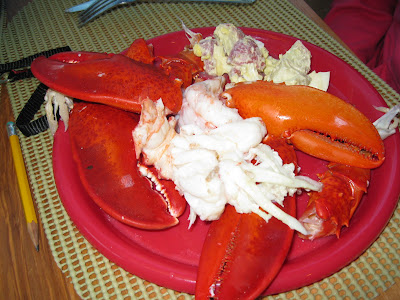
With the recent full moon in Pisces (sign of the fishes, for those out of the know) and the last long weekend of the summer, it was the perfect time to go Maine for a last hurrah and maybe a lobster or two.
The Marginal Way in Ogunquit.




This is one of my favorite places to walk in Ogunquit. It runs for about a sinuous mile along the coast and features beautiful, soul-retrieving views. And, with good eats on either end (downtown Ogunquit and Perkins Cove), the walk becomes a gastronomic excuse.
[Now that the summer is over!] My
quest for a local fish market has been achieved. Capt'n Hook's has a fish
market, fried seafood and an outdoor
lobster bake.
Lobster prices have been really low, so we've been gorging ourselves, shamelessly.
But then there is the Wells Estuary at Laudholm Farm, where you can walk it off.
This was the view today. Notice the almost total lack of humanity. Did I also mention it only costs three bucks to park? Yeah.
I found this weird, pink snail shell with pink seaweed growing out of it. It looked like the snail meant to do that.
Right now I'm wondering, "Why don't I live here . . . ?"
Monday, June 22, 2009
Film Review: Food, Inc.
On a muggy and misty Friday afternoon, after my macrobiotic lunch at Masao's Kitchen, I finally settled in to watch the documentary, Food, Inc. I've been anticipating this for a long time, and ever since I read The Omnivore's Dilemma about a year ago, I've been waiting to see how that book and others like it would or would not cross over into mainstream consciousness. While chomping on my GMO popcorn (which I thought was "funny" and ironic when I bought it . . . and disgusting when I was about halfway through the film) and a smuggled cookie from Masao's, I and a small handful of concerned citizens -- all "older folks" who have probably read the books The Omnivore's Dilemma and Fast Food Nation -- sat in contemplative, respectful silence to watch a film we likely already knew the content of. Like the dutiful choir, we eagerly accepted the preaching of the latest by director, Robert Kenner, and the authors, Michael Pollan and Eric Schlosser. The question for me is: does this film have the power to transcend the faithful and reach the unconverted?
The main point of this film is to show how the vise-like control of the agriculture industry by a very few (4 to 6), huge corporations is rapidly destroying the integrity of the American food supply at every level. The film, like Sinclair's The Jungle in its time, descries the sloppy mess that industrialization and monoculture have brought to the table. Many images of factories with byzantine braids of conveyor belts, pipes and gears, feedlots of previously unimaginable scale punctuate the film to remind viewers of the reality of most supermarket food. For example, with so many steers in such disgusting conditions all funneling through the thirteen slaughterhouses in the country, we see for ourselves how one hamburger can be a composite of a thousand animals, making the ultimate source of food-borne illnesses practically untraceable.
And who are the workers in charge of the most brutal, messy and dangerous work? Certainly not well-paid industrialists. No, it is the undocumented worker and the marginalized individual with no other skills that is forced to process thousands of animals each week. Doing this kind of work must have a psychological effect. And the fact that we allow for these abuses, both of the animals and the workers, underscores a comment made by Salatin: "How we view animals reflects how we view others."
Read my other posts about this film and topic:
10 Things You Can Do . . .
Saturday, June 20, 2009
Happy Summer Solstice from Fiddlehead

In the month of June, everyone becomes a pagan. Even the most stern Puritan cannot deny the pleasure of the summer's first, ripe strawberry. Now, so close to the first official day of summer, the fruitfulness of the earth begins to tell us the story of what we have planted and nurtured, what we have invested in and what has grown from our careful tending.
It's now the time for lots of greens: Swiss chard, kale, lettuce, mesclun, arugula. Having lots of greens makes me think of having lots of "green" -- money. Abundance is a wonderful thing, if it's what you want. I especially love "hot," picquant greens like arugula and mustard. Their peppery flavor tastes of good health, vigor and clarity (there's no mistaking a mustard green for iceberg lettuce in your salad!). While some folks crave the bitter herbs, I'm not so inclined. Dandelion greens? You can keep them. I have no love for their bitter, astringent taste. They make me think of all the things that other people say are good for me. What do they know? I follow my own taste buds, and I'm never wrong.
I look forward to a season of chard tarts, seared kale and pungent salads.
It's also the time of the first round of berries: strawberries. Whether we turn them into jam, bake them in pies or simply eat them without adornment, strawberries are among the temperate world's most favorite foods. One of my favorite memories of Canada was eating a bowl of tiny, wild strawberries that my memere had picked herself. She is a big fan of the sweets, so the strawberries had been dusted with sugar -- and she served them in cream. Not milk. Cream. I can't say it was decadent because a breakfast so simple (only three ingredients) defies the sense of the word, but the joy of such a meal cannot be described. And, isn't this what our grandmothers are supposed to do for us -- spoil us silly with our favorite indulgences?
I am happy to say, that from the look of our farm share, abundance and indulgence are in store for us this season. What a welcome sight after such a year of economic (and personal) strife. The question becomes: what will we do with all of it? Some people express despair when they see their box of food from the CSA. They might recognize the produce, but many folks have forgotten what to do with these early vegetables. This is regrettable, since our grandparents and great grandparents certainly knew what to do with fresh, local food. With each week's box, I am reminded of the canning section in my great grandmother's cookbook. I also know that I will now have lots of greens to freeze for a dreary day in winter in need of a hot soup. I know that the compost pile at the garden will start to reap the benefits, too, producing more rich earth from all the cuttings and leftovers from the gardeners' plots and kitchens.
What we do with our abundance is an important statement about our values and our ability to invent. Eating from the CSA box (or the garden) and not the fast food restaurant forces us to look at what we truly have, right here, right now. What if we actually had to live on it? Couldn't go to a supermarket to get more or different? Could we make it work? Make it stretch to the next week? Surely, we could with some inventiveness and will.
Creativity, passion, intention. Clarity, discernment, hope. These are the other green and growing things -- the intrinsic, intangible things -- I receive each week in my box. I hope I am worthy of this plentitude and use it, love it, wisely.
BTW, the image above represents only half of the share. The other half goes to Seth's mom.
Monday, June 15, 2009
Food of the Wild Soup

I’ve wanted to make something like this for a long time: collect several wild edibles and put them together into a great-tasting dish. Here, I’ve combined fiddleheads, stinging nettles, shitakes (yeah, well, they’re wild somewhere; I don’t know my wild mushrooms well enough to be safe) and arame (Japanese sea vegetable) for a soup in honor of the wild foods of both land and sea.
Food of the Wild Soup
First, soak about ½ cup of arame in cool water for 10-15 minutes. If you do this first, by the time you finish the other steps, the arame should have plumped up to twice its original size, which means it’s ready.
While that’s happening, please heed the warnings and follow the directions for preparing nettles seen here.
After you’re done blanching the nettles, you’ll need to do the same for the fiddleheads (but a minute or two, once, is long enough).
Next, you need a dashi, which is a Japanese broth flavored with sea vegetable (usually kombu) and bonito flakes. If you don’t have these weird ingredients – I never do – use a vegetable stock and improvise with some dried nori (the seaweed they wrap sushi in) and some fish sauce (or fish stock). Put 4 cups of dashi/stock on the back burner, add some grated ginger if you like (I like) and a teaspoon of soy sauce, and just let it start simmering.
Meanwhile, heat a small amount of oil (not olive oil, here. Safflower, grapeseed, peanut would work) in a skillet. Add 5 or 6 chopped shitake caps and 1 small leek, sliced (white part only). Add a pinch of salt and a dash of sake (optional).
Add the fiddleheads and nettles, season with salt and black pepper and stir to incorporate.
When the shitakes are slightly browned, add mixture to the dashi. Keep heat low. Add the arame.
Before serving, take about ¼ cup of the broth and add to 2-3 tablespoons of red miso to dissolve. Add the dissolved miso back to the pot, stir and serve.
I serve this with udon noodles, which I prepare separately to prevent them from sucking up all the liquid in the soup.
Here are some other articles and comments about nettles:
"The Common Stinging Nettle" by Euell Gibbons, writing for Vermont Weathervane
"Stinging nettles -- I cooked them and lived!" at Chowhound
"Stinging Nettles Need a New Name!" at OrganicMania
"Mini Specialist| Food Found: Stinging Nettles" by William Snyder, writing for WSJ
Check out these recipes:
Nettles pasta with fava beans, from No Recipes
Spring Tonic Nettles Soup, from Wild Food Ways
Sunday, June 14, 2009
Today's Lunch Spot: City Feed in JP

The Boston neighborhood of Jamaica Plain is a funky, artsy, conscious community with a vibrant ethnic presence and a real sense for what is now in food trends. And nothing is more now than the push to "get to know your farmer." City Feed and Supply (now in two locations in JP) is part corner grocery store, part coffee-sandwich shop. But the place proves Aristotle's assertion of holism . . . the whole is greater than the sum of its parts. If you're a vegetarian, a flexitarian, if you've read Pollan's books and you're afraid to eat meat or produce from the big, Gigantaursarus Mart, shop here. If you want red quinoa from a local grower, heirloom tomatoes grown in EASTERN Massachusetts, local, raw honey, shop here. If you want old school candy for a quarter -- Mary Janes, for example -- shop here. Most of the food is sourced locally and is sustainably or humanely produced. The retail store is so small that it defies the current "wisdom" that says consumers want endless variety. Conveniently located on Centre St. in the middle of all the action, it's easy to just pop in for a coffee and a poke about the store. It's the kind of shopping where you aren't planning for the week. More likely, picking up some fresh herbs to top off a pasta dish or a delicious bread, or, "Oops, forgot to get canned tomatoes, so thank god they have it here and I don't have to go to that other place." It's amazing what they do have in such a small space (But, it's probably the same size as the grocery stores our grandparents and great grandparents remember). It seems like it would be a good place to go if you actually cook, not reheat/microwave/assemble, your food.
Or, you can eat from the cafe. Today, I had an amazing, hearty sandwich, the Farmer's Lunch: extra sharp cheddar with whole grain mustard and mayo, granny smith apple, small-batch pickles, and romaine on a delicious baguette. I eat bread rarely, so I was pleased that the bread was so good. I also ordered a cup of chipotle sweet potato soup which was outstanding -- a smokey-spicy kick really stands up to the sweetness of the potato, and the use of (I'm guessing) thyme and tarragon really brightened it up. I loved this lunch, but it was way more food than even a very hungry girl could eat -- so I get to finish it later, either tonight or tomorrow. Yum.
Subscribe to:
Posts (Atom)